


Just before the Great Buy Black Bonanza following the George Floyd uprisings, I sat down for an interview with Slim Thug and Eboni K. Williams on REVOLT TV. Even before the summer of 2020, the winds had already been blowing that way, billowing towards a renaissance of Black capitalism, and I wanted to warn of the futility of the coming storm. The year before, I had written an article criticizing Black consumerism. On REVOLT, I hoped to push our discussion around Black blight beyond budgeting and self-help. In our dialogue, I found Slim Thug and Eboni to be thoughtful, patient, and open-minded. Yet in the end, our conversation (it was billed as a “debate”) kept circling back around to the economics of responsibility.
“I think it needs to be a lot more rappers investing in these neighborhoods, you know, they representn’ you know, what I’m saying? I think we need more Black businessmen,” Slim Thug told me. “With the same confidence, we got going to buy these chains, these $100,000 chains—we can get in the neighborhood and open up some of these businesses. And then we won’t have to worry about these people or depend on them. We can kind of just do our own thing. That’s what I’m really about.”
I got it; I knew what he was saying.
And in the days after, I couldn’t stop thinking about how I had heard Slim Thug’s argument many times before, almost every time I put on my headphones, in fact.
In hip-hop, the import of the Black businessman, the dream of becoming your own boss, is something of a prerequisite, a cornerstone to the rappers’ origin story, and a necessity for liberation from a life of strife.
This is why so many songs speak of CEOs, honchos, and dons. This is why every rapper from Raekwon to Gucci Mane has shouted out Donald Trump or why every emcee from Nelly to J. Cole has paid lyrical homage to Bill Gates. Yet of all of hip-hop’s entrepreneurial personas, none remain more powerfully persistent than that of the pimp.
Pimping looms large in rap music. It leaps from Jay-Z’s “Big Pimpin,’” bounds from Kendrick Lamar’s To Pimp a Butterfly, and slides on Slim Thug’s “Like a Pimp Flow.” Pimping anchors hip hop’s cinematic endeavors like Hustle & Flow or Pimp. Pimping drives the narrative in proto-hip hop novels, such as Iceberg Slim’s Pimp: The Story of My Life. Throughout these works, pimping signifies not only sexual prowess or stylistic sophistication but also a unique and particular mastery of capitalism’s inner workings. As the writer and social critic Mychael Denzel Smith explains in Stakes Is High, “pimping is capitalism in its purest form.”
“All the profits generated by labor end up in the hands of ownership/management that performed none of the labor,” Smith notes of pimping. “The workforce is viewed as dispensable, replaceable the moment they refuse to toe the line. Violence, both implicit and explicit, is central to regulating the worker.”
Callous as it may seem, for many Black toilers, the promise of collecting rents instead of paying them—of pimping instead of hoeing—holds deep appeal. Yet ironically, while so many rappers narrate their songs from the perspective of a pimp, their careers often mirror something closer to that of an exploited sex worker. Take Mase. The wavy Harlem rapper once recorded the ode to pimping, “The Player Way,” featuring rap legends 8Ball & MJG, only to confess years later that Bad Boy Records had him in a “slave contract” and that he had been cheated of millions. He had been pimped. Then there’s Lil Wayne. The prolific New Orleans prodigy recorded tracks such as “Pimpin,’” “Workin’ Em” and “Where da Cash At,” only to allege years later that Cash Money Records and Universal Music Group had cheated him out of tens of millions of dollars. He had been pimped. From Lil Uzi Vert to Rich Homie Quan, a bevy of rappers have recounted similar horror stories of being siphoned by labels. Jostling far beneath hip-hop superstars, thousands more rappers, anonymous to most, struggle to make it, remaining locked up in bad contracts and praying to Big Tech for pennies on each stream. Pimped, all.
This all remains an open secret, of course. We’ve all heard the testimonies of rappers who’ve blown up without their labels paying up and tales of the musicians producing big hits who never hit it big.
Publications like Noisey have written entire series on the ways corporations extract money out of Black artists. Anyone immersed in rap knows that during a hip-hop beef, one of the first things emcees dredge up is their rivals’ pockets being sucked dry. This is exactly what Remy Ma did. In 2017, when she quarreled with Nicki Minaj, Remy spat, “Stop talkin’ numbers, you signed a 360 deal/Through Young Money, through Cash Money, through Republic/Which means your money go through five niggas before you touch it.” It is what Drake alluded to in “Two Birds, One Stone,” saying, “Fuck the rap game/it’s all lies, and it’s all filthy/Two percent of us rich and the rest of these niggas all milk it.” Or as Jay Z said of Drake last month at The Roots Picnic, “Them crackers got your publishin’, gangster; go talk tough to them/Don’t talk success to me, you niggas is workers/In perpetuities, how your contracts is worded.”
Tragically, through lyrics and lawsuits, the rap game is revealed to resemble the pimp game, just not in the way that so many artists wish. As rappers boast of their pimping exploits, executives exploit them. As emcees sing of whooping tricks and beating hoes, smiling A&Rs listen along, rapping word-for-word, following the instructions to the letter, ensuring Black musicians pay up to Universal and Sony every Friday at five o’clock on the dot.
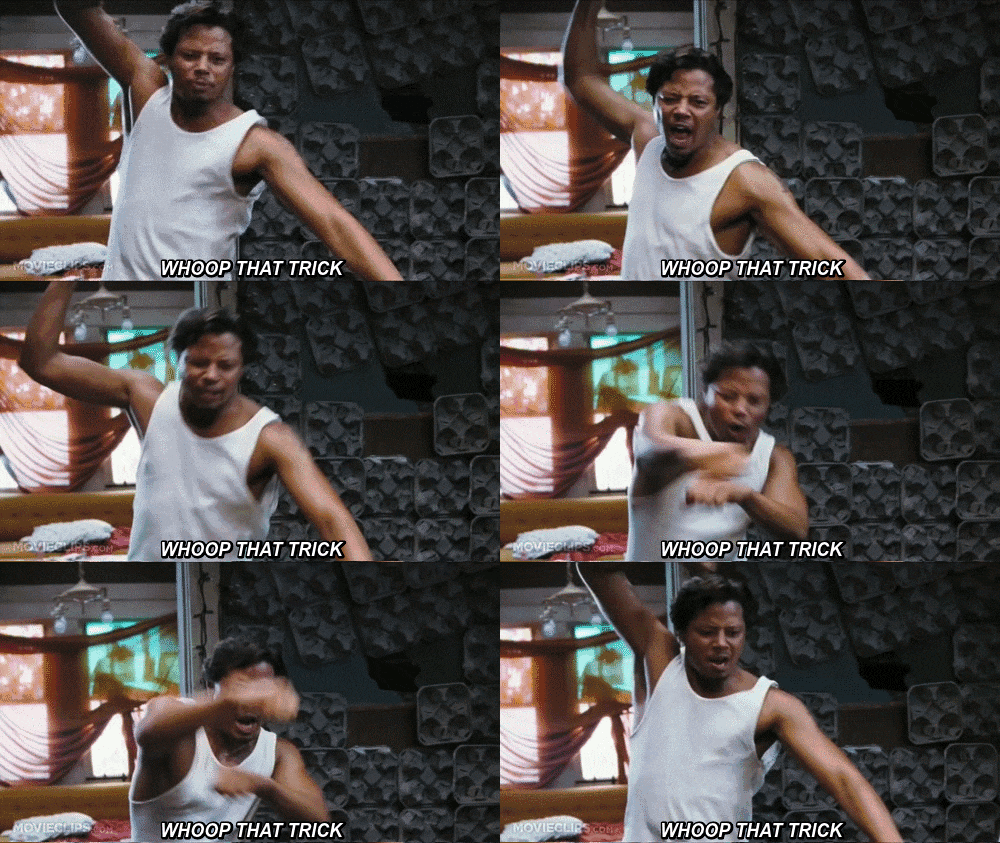
Yet despite all of this, despite the open pillaging of our “hip-hop bosses,” despite the naked theft of our “baller businessmen,” the dream of the indomitable Black entrepreneur lives on. In the economic logic of hip-hop, if Black folks are poor, it isn’t that the game is to blame but how we play it. It’s not the structure of the economy, but the lack of effort we put into it. It’s not that we have been set up to lose but that we’ve yet to strive to win, yet to become the best pimps we can be.
For so long, I found it hard to fault those who still believe in this dream. It’s intoxicating. Black capitalism’s phantasmagoria blends Nipsey Hussle’s groove with Ebony magazine’s gloss. It is Black brunch before Howard homecoming and Black bars after Mardi Gras. It is Black vendors hawking lavender incense, rosemary candles, sacred crystals, fine chocolates, fine liquors, and fine dining. It’s a never-ending Players Ball, where we all buy back the block, recirculate our dollars, and mind our Black-owned businesses in an opal opulence.
Yet Black capitalism is quicksand. It confuses solidarity with patronage — demanding Black consumers’ support for owners without asking owners to do anything for the Black community. It fails to wrestle with monopoly and plutocracy. It has no sense of macroeconomic scale. It urges the richer to exploit the poorer. And it deludes the poor into thinking they can work “hard” enough to become rich.
***
A year after my chat with Eboni and Slim Thug, I found myself watching REVOLT TV again. It was a Drink Champs episode with Big Sean, aka Sean Don, the boss himself — “the don dada” whose affinity for pinky rings and fur coats harkens back to hip-hop’s earliest pimping traditions. Like all Drink Champs benders, Sean’s conversation blended nostalgia with aspiration, creating the cocktail of capitalist lore one would expect from a corporation then-owned by Diddy. Maybe it was the clouds of weed smoke. Maybe it was the liters of Ciroc shots. But somewhere in the crossfade, as Sean reflected on his years writing for GOOD Music without owning his masters, you could feel his boss persona slipping. He’d been exploited. He was angry. He said that he had been bilked out of tens of millions, that his agent told him his contract was the “worst deal that he had ever seen”, and that he’d been made to work in an unfair arrangement for free.
However, sadly, Sean still referred to his contract as “a golden opportunity” and said that if he wanted to be free, “I had to work my way out.” Upon hearing this, I thought that there was perhaps no more perfect articulation of the thesis of Black capitalism.
To say that labor can outwork capitalism is like saying a hamster can outrun its wheel, like saying an ox can win a game of tug-of-war with its plow. These are not the words of a boss, but the words of a worker—not the words of a pimp, but the mantra of a tragic working class that has been woefully, deceitfully, ceaselessly tricked.


