

Rappers once waged war on wage labor. What happened?
How hip-hop came to embrace capitalist exploitation.

I. “This grave shift is like a slave ship.”
Barreling from the Underground Railroad all the way through underground hip-hop rumbles a train of thought deploring wage labor—despising hourly employment as merely America’s newest manacles.
This is why Common spits, “Writin’ for my life ‘cause I’m scared of a day job,” or why SZA croons, “Run fast from my day job, runnin’ fast from the way it was,” or why Lil Baby proclaims, “I cannot work me no nine to five.” It is why 2Pac curses the torture of “striving, working nine to five with no health care” and why Lil Yachty sings of a promised land where there “ain’t no nine to five.” From Jazmine Sullivan’s sultry soprano growling “fuck a day job” to Jhené Aiko’s wispy falsetto declaring “I can’t get by on minimum wage,” Black artists have ceaselessly depicted the personal hell of toiling as personnel.
Even in hip-hop’s progenitors, one can hear labor’s loathing. Listen to Michael Jackson pleading with audiences to “leave that nine-to-five on the shelf.” Wrestle with Luther Vandross’s belting, “Who needs to go to work for another dollar?” Here in Black music, one hears an ancestral yearning for something higher than being hired.
Since the end of the Civil War, since the days Black Union soldiers first blew their bugles as freed slave children sang “John Brown’s Body,” Blacks have believed that to be an employee was to be unfree—was to be under lock and key.
As historian Julie Saville explains in The Work of Reconstruction, “former slaves [were] little inclined to accept such terms of wage employment as the fulfillment of emancipation.” Or as The Free South, an abolitionist newspaper, wrote in 1863, “labor for wages, as the only means of subsistence, is but a modified servitude.” Or as Brown University political scientist Alexander Gourevitch writes in his post-Civil War study, “From the abolition of slavery to the end of Reconstruction, many freed slaves sought more than legal recognition as equal citizens… They refused to work for former masters, even when offered a formal labor contract and wages.” And as Duke historian Justin Leroy cogently explains, Black abolitionists insisted that “freedom would not be found in transforming millions of slaves into wage laborers” and that Blacks considered “wages without ownership of land or capital as merely a more sophisticated form of slavery.”
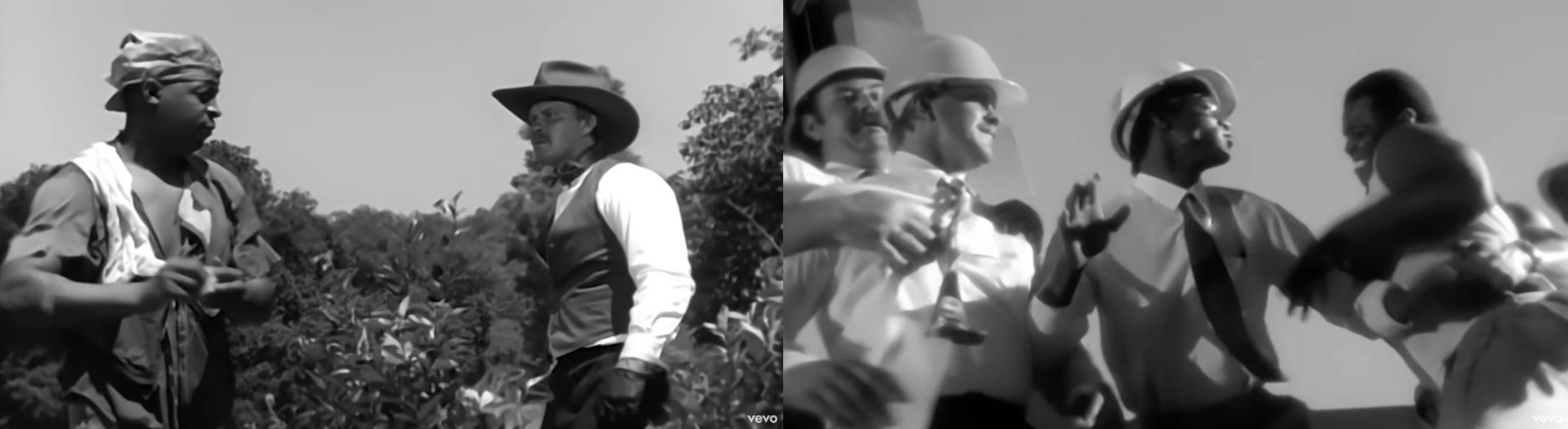
This notion that wage labor is slave labor runs through the work of David Walker, to Ella Baker, to Martin Luther King, all the way to modern emcees. Think of Public Enemies’ “Can’t Truss It” music video, where scenes of chattel slaves sweating on plantations collide with images of Black workers toiling in industrial plants. Think of J. Cole’s lyrics portraying employees as “just slaves for a wage” and his “G.O.M.D.” video where he plays a slave fighting in an uprising. Think of Nas’s Untitled album cover, his back exposed, keloided lashes strewn across his shoulders and spine in the style of the infamous 19th-century portrait of “Whipped Peter.” Think of all the ways that hip-hop tackles the endurance of slavery’s shackles, how the rhythms reveal bondage bounding across the centuries, how the rhymes expose the chains in our modern supply chains.
It’s haunting. You cannot hear Dead Prez describe “getting paid commission” as “minimum wage, modern-day slave conditions” and then clock in to Amazon unbothered. The similes stalk the psyche. Just as you cannot listen to Isaiah Rashad sing “a penny saving, minimum wage is some shit/plantation slaves to the modern day” and report to work at Waffle House unfazed. The metaphors seize the mind.
Hip-hop—in its sharpest moments—asks listeners to reappraise the prize of emancipation, to reconsider if the economy we suffer under is truly freedom.
Over 150 years ago, Frederick Douglass made the case that it is not.
At the dawn of abolition, Douglass described recently “freed” Blacks working for a wage as no longer “the slave of the individual” but as “the slave of the society.” After the Civil War, Black workers were still whipped and lashed by hunger and poverty, still forced to sell themselves into peonage and wage slavery. This is the wretched “freedom” described by a Union army commander who wrote, “The liberty given [the freedpeople] simply means liberty to work, work or starve.” It’s why historians like Gourevitch note that emancipated Blacks “were free to ‘give themselves a master,’ but they could not choose not to have one.” It is why Marx described the dismal difference between the chattel and wage earner as one where “the slave, together with his labour-power, was sold to his owner once for all,” whereas “the free labourer, on the other hand, sells his very self, and that by fractions. He auctions off eight, 10, 12, 15 hours of his life, one day like the next, to the highest bidder…to whomsoever buys them.”
In the 21st century, as Blacks continue to spend our working days in a daze, as we toil as on-demand maids, as Task Rabbits, DoorDashers, Uber drivers, Rovers, and Grubhubbers, Marx’s depiction of workers auctioning the self by the fraction to the highest bidder reads like some sort of terrible prophecy made true. Today, as we walk dogs and haul groceries, Black giggers hum Rod Wave and Glorilla as surely as our ancestors wailed “Go Down Moses” and “Hammer Ring.” Rap songs are our new work songs. They are our Negro spirituals. They are how we keep time and keep sane. They are our coded messages where we learn to wade in the water, and to steal away. They are our notes and keys to freedom.
And yet for all of their subversive radicalism, Black musicians who have long revolted against the labor regime now seem poised to protect it. As hip-hop has grown, the rebellious artists we once rooted for seem to no longer want to uproot the wage system. The conflict is littered throughout artists’ catalogs.
After all, how is it that Rick Ross raps about horrid double shifts and backbreaking roofing jobs, yet also owns dozens of Wingstops where employees make minimum wage? How is it that GloRilla can star in her “Yeah Glo!” video playing an irate fast-food serf quitting her dead-end job while she’s also recording promos for Checkers? What do we think of Travis Scott crooning about the soul-numbing tedium of “part-time work at Sam’s” while also eagerly embracing his McDonald’s partnership? What are we to make of the chorus of emcees brazenly bellowing “fuck a job” as they also raise their pitch-perfect voices to make the perfect pitches for fluffy breads and greasy burgers prepared by shackled employees?
Artists cannot at once wage war against shitty jobs while also shilling for the leading providers of the minimum wage. Yet this is exactly what hip-hop has done. Today’s most virulent critics of wage labor exploit wage laborers the first opportunity they get. The result is a poetic injustice, a warping of artistic abolitionism to the ends of capital.
Blacks’ critique of wage slavery still stands. As Joey Bada$$ once sang, the American economy is still “planting plantations.” Or, as Kanye’s College Dropout declared decades ago, grave shifts bear far too many similarities to “slave shifts.” In America, our working lives are still anchored by the auction block. The tragedy of Black music today is that we, the descendants of the subjugated, now subject others. Under the sway of capital, the musical progeny of field hands now vie to try their hand at the whip.
***
II. “When I die, bury me inside the Louis store.”
Like all insurgent artistic movements, hip-hop’s inevitable rot grew from the spoils of success. The glut of lucrative sponsorships and corporate contracts contracted artists’ sense of political possibilities and reeled in their rage at wages. Today Black musicians are more focused on album advances than advancing the race—more interested in collecting interest than in fighting for the interests of working people.
Nowhere is hip-hop’s financial corruption clearer than in the ways rappers slavishly make it their business to promote big business. Take any random sample of the hip-hop verses today, and they add up to a series of ads—a series of pitches to don Chanel, drive Cadillacs, and drink Cherry Sprite.
No NBA commercial break is complete without a Megan Thee Stallion Dunkin’ Donuts protein shake commercial where the Hot Girl coach stars as “ProTina,” the fitness instructor teaching you how to drink a shake while busting a split. No scroll on Instagram is done until you thumb past Ice Spice playing the role of “Ice Spicy” in a Wendy’s ad promoting hot chicken sandwiches through her custom nails and neck tattoos. No Spotify stream is over until you’ve heard a bizarre brand collaboration, like JID’s “HEY TONY,” promoting Frosted Flakes along with limited-edition Tony the Tiger jerseys and T-shirts.
On the red carpet, rappers evoke a NASCAR-chic vibe, as every inch of their bodies displays sponsored decals and brand labels. In music videos, emcees cosplay HSN infomercial hosts, using the soundtracks to sell tracksuits and jam sessions to hawk jelly biscuits and triple-distilled tequilas. Hip-hop’s fusion between emblems and emcees—between Guccis and Gucci Manes—is now so complete that it is difficult to tell where the brands end and the artists begin.
When songs refer to “YSL” today, it’s not clear if it’s alluding to a French fashion house or an Atlanta gang of stoner rappers. Much like when tracks mention “Maybach,” you can never be sure if it’s a reference to a German luxury car brand or a band of artists led by a former Miami correctional officer pretending to be a drug kingpin.
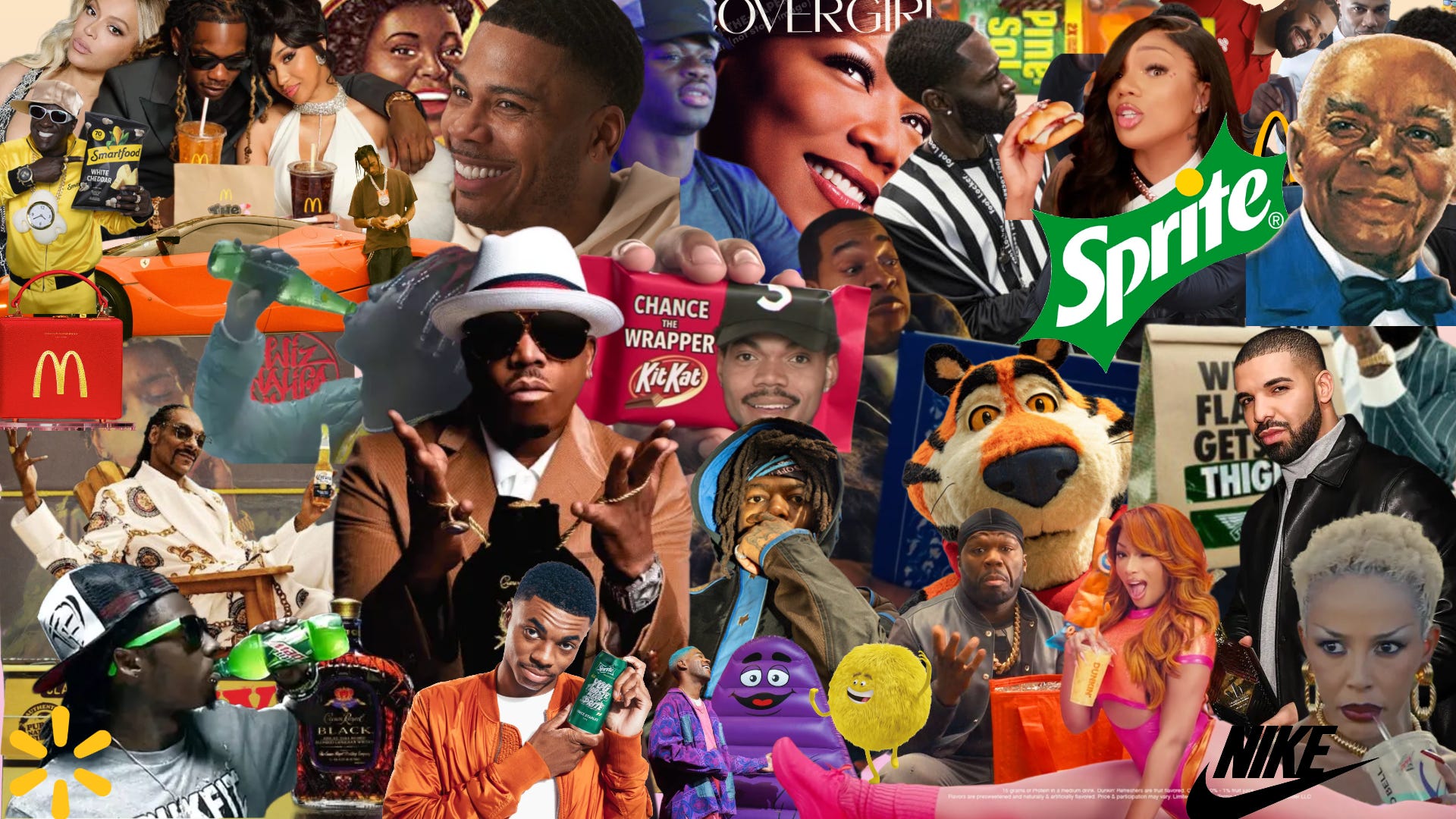
For our corporate overlords, this melding of street icons and iconic brands helps defuse Black’s long-running critiques of racial exploitation and inequality. Capitalists now make it a point to appoint a few slum dwellers to the ruling class to satiate our desire for escape from wage peonage. Through hip-hop, monopolists have fashioned a politics implying trendy brands will free you from the bonds of labor. Like Travis Scott boasting about his Nike deal when he raps, “You see these kicks, nigga? / Made checks off the right steps,” hip-hop argues that with the right outfit, you too will fit into the upper class. That if you style yourself after A$AP Rocky and dress fly like Playboi Carti, you too can fly on private planes.
This notion that donning Prada bucket hats will help you keep your head above water, or that wearing Fendi gloves will help you make money hand over fist, is, of course, a ludicrous delusion. Rolexes don’t get school janitors more time off, just as wearing Red Bottoms doesn’t help hotel housekeepers kick up their heels. Despite this reality, however, hip-hop has managed to popularize an escapist consumerism that replaces radical theory with retail therapy.
Today aspiring rappers speak of “Beamers and Bentleys” as they spring over the turnstiles to sneak on public transit. Their fans are the urban poor pouring Moët, claiming to be “temporarily embarrassed millionaires.” These artists and audiences are Black capitalism’s tragic victims. They are the gameless players and the stagnant hustlers; the mumbling macks and the impotent pimps; the idle busybodies, the broke bosses, and the well-heeled welfare recipients. These are those whom George Schuyler once lampooned as Blacks “intent on emulating Rockefeller and Ford on shoestring capital.” Today, they are the poor souls Chicago lyricist Noname rapped of on “Rainforest” when she asked, “How you make excuses for billionaires [while] you broke on the bus?”
At times, it feels as if the entire genre is trapped in Pardison Fontaine’s 2017 song “Food Stamps,” where the New York rapper brags about having “food stamps for sale,” while his girlfriend is plotting on Christian Louboutin’s and Chanel.
Yet despite this painful irony, so many of hip-hop’s beggarly ballers are bizarrely at peace. It’s not that they don’t know they’re capping for billionaires as they steal bus fare. It’s that through hip-hop, they’re able to inhabit a world where delusional flexing is a prerequisite to one’s inevitable escape. Think of how Drake sings about buying his ex-girlfriend “a fake Chanel wallet”; or how Chance the Rapper openly admits to lying about wearing Yohji Yamamoto’s Y-3 when “really, they was Roshes”; or how Kanye belts out about how he “went to Jacob with twenty-five thou before I had a house and I’d do it again ‘cause I wanna be on 106 & Park, pushin’ a Benz. I want to act ballerific.”
Rappers consciously admit that they can’t afford the consumption that they market, even as they position brands within the Black imaginary as the key artifacts of liberation. Hip-hop’s truisms tell audiences that—even if they can’t afford it—they should dress for the job they want to have, and eventually they won’t need a job at all. Eventually, they will be free from the trials of wage labor. The tragedy of this is, of course, that unlike the rappers spitting these lines, most of us who fake it will never make it. The more we live by artists’ lyrics, the more we are trapped playing the role of the impoverished aristocrat, forever shuffling in line for affordable housing in our Tom Ford loafers, slowly aging without pensions or benefits.
Of all its insidious accomplishments, the biggest legacy of corporate hip-hop is swapping musical labor solidarity with jingles of imagined prosperity. Today, as rappers write songs affirming firms, lyrical window shopping subsumes critique of economic domination. This bevy of free-market freestyles has tilted Black public philosophy toward neoliberalism. It has ballooned the ranks of those among us who see themselves as a kind of prosperous poor. Black people have been chained by the very rhythms that were supposed to set us free—trapped by the trap drums thumping us into a woeful groove, beckoning us to dance in that terrible carnival of Black capitalism, in that pitiful parade of flightless jet-setters, stammering smooth talkers, indecisive shot callers, and pageless paper chasers who forever laugh and toast to the figment of their fictive success.
***
III. “Tired of that overdrive, that commercialized sing-along.”
Through toy drives and turkey giveaways, hip-hop’s megastars try to convince us that there’s not a concerted effort to commercialize concerts. At the Met Gala, Black artists raise their cloaks and lower their diamond masks hoping to hide how their corporate allowances allow Black communities to be decimated. Yet after all these years of watching rappers keep such close company with Fortune 500 companies, it grows harder and harder to pretend that emcees’ stage acts are acting on behalf of some greater good. No matter how many gang signs they flash, we can sense they aren’t showing their true colors. And no matter how much they boast of Glocks and choppers, we can still see they are not shooting straight.
In 2023, during hip-hop’s 50th anniversary, some music critics mustered only grumbling tributes and sighing salutes. There was a sense that the genre was drowning in too many profanity-laden verses swearing loyalty to Adidas and Audemars. Too many DJs putting a street spin on product placement. Too many sponsored content pop-ups and affiliate marketing gigs rendering the 808s humdrum and the poetry prosaic. As Jason England put it in the Defector, “Hip-hop has become ornamental. Biggie is on Old Navy and Gap t-shirts,” and the genre was now “fully married into global hyper-capitalism.”
Yet so many fans recall something different—recall a time when listeners could easily hear the republicanism of our enslaved ancestors in rap music. The republicanism that rejected wage labor and compelled Frederick Douglass to call for cooperative unions. Today however, the Republicanism in rap is more that of Donald Trump features on Kodak Black songs. It is the Republicanism that has drawn Benny the Butcher and Sexyy Red toward the MAGA coalition through the allure of tax cuts and “a businessman in the White House.”
Shredding and ripping, you can hear hip-hop fighting for its soul. One second, Cardi B is campaigning for Bernie Sanders and his platform of employee ownership; the next, she’s rapping, “I’m a boss, you a worker, bitch,” as she films McDonald’s ads and invests in landlording. On one song, an artist like Nas will spit, “Really what’s in my mind is organizing a billion Black motherfuckers/To take over JP Morgan and Goldman and Sachs/And teach the world facts and give Saudi they oil back”; on the next, he is droning on about how he’s grown wealthy “from money off tech” and lives life “one IPO to the next.”
Much like these divided artists, hip-hop is tugged between the people and the plutocracy. The plutocrats’ agenda is clear. They intend to keep turning acid raps into saccharine pitches for Kit Kats, to continue producing what Big KRIT lambasted as “commercialized sing-alongs,” which “celebrate the very shit that slows us down and probably kill [us].” Yet despite the countless billions spent on corralling artists into defending an economy they’ve long denounced, the war for Black music is not yet lost.
Even with all its foibles, hip hop still offers (from time to time) perhaps the most radical mass media labor critique—a structural critique not just asking for better jobs with fewer hours and more pay but questioning the construct of a job in the first place. It’s one of the few pop-culture mediums making the case that workers should be free of owners altogether, that laborers themselves should own the fruits of their labor and direct their actions and their economic lives.
In our post-Occupy, post-Bernie era, as leftists grasp and fail to find ways to connect with the Black masses, hip-hop still offers a means, language, and aesthetic to voice the populist fury of America’s long-languishing Black working class. Yet, if the genre is to achieve its potential, if it is to become the gadfly that it can be, we must call it what it is right now—corrupt. If we do not, if we continue to pretend that it is something else, we will be trapped in the bars that rappers spit at us, trapped by capitalist anthems that make us sway and twerk to the beat, as we dance on our own graves.
Love this! You write like an MC. I also wonder who is attracted to hip hop as an art form or career path and why? I feel like it's people swayed by capitalism or patriarchy more so than seeing the potential of the art form to say "fuck the police." Or of course, those are probably the only rappers getting signed and paid. I'm sure there are plenty of exceptions.
Aaron, no pressure, but when we getting the public reading?! Love the musicallity of the words on this joint. Solid work!