

Are BBLs dystopian?
We now go under the knife to get our slice of the pie—but at what cost?

Malcolm X, our Black shining prince, that sage who taught us to love the shape of our noses and lips, also once urged us to scorn the girth of Black thighs and hips. As Manning Marable wrote in his Pulitzer Prize-winning Malcolm X: A Life of Reinvention.
In a 1955 lecture at the Philadelphia temple, Malcolm ordered the local leaders to purchase scales and to “weigh the members” every Monday and Thursday. “Those who are overweight,” he warned, “will be given two weeks to lose ten pounds or will be given time out.” He anticipated that his draconian edict would not be popular: “I’d better not hear anyone mentioning my name in criticism, or I will give them indefinite time out of the temple and might keep you out of here for good.
Here, even Malcolm, evangelist of Black self-love, could not escape the logics of self-hate. The tragedy of Black aesthetics is this—we have long warred against a society that treats those with fair skin more fairly, even as we have hailed a hierarchy that degrades those who are fat, plain, or frumpy as worth less.
This caste of beauty—this link between looks and social outlook—isn’t a ranking system I first learned in reading Malcolm or Manning, but in the pulpy pop culture of my youth.
Growing up, every week, my family would huddle around the TV to watch Extreme Makeover. Not Extreme Makeover: Home Edition, where teetering families begged Ty Pennington for renovated dwellings, but ABC’s original Extreme Makeover, where sad, pilgrim-looking participants pleaded for nose jobs and tummy tucks from America’s most talented plastic surgeons. Each week, we would gasp as the doctors worked their magic, transforming saggy titties into treasure chests and filling pancake booties into rounded pound cakes. It was a ruthless program. As Slate put it, it was “the most violent show on TV” and consisted of a “weekly documentary on which two homely people are sawed and sanded into two beautiful people—and thus granted deliverance from the travails of existence.” Yet bizarrely, it was far from the only one in the genre.
We’d watch Fox’s The Swan, where surgeons showed us how much facelifts could raise your face value. We’d watch NBC’s The Biggest Loser, where “overweight” contestants competed to turn their back rolls into bankrolls in a $250,000 competition in which entrants were paid off to get the pounds off. On weekends, I’d watch TBS movies like Down to Earth, where Chris Rock would heckle audiences, yelling, “The uglier you are, the smarter you better be. You need a book for every ten pounds you’re overweight!” And no one could escape Eddie Murphy’s terrible magnum opus. The Nutty Professor, where Murphy transformed into Sherman Klump, a self-loathing, obese scientist who grows into a monstrous, Godzilla-like giant, roaming Los Angeles, stealing turkey legs, and farting out nuclear mushroom clouds.
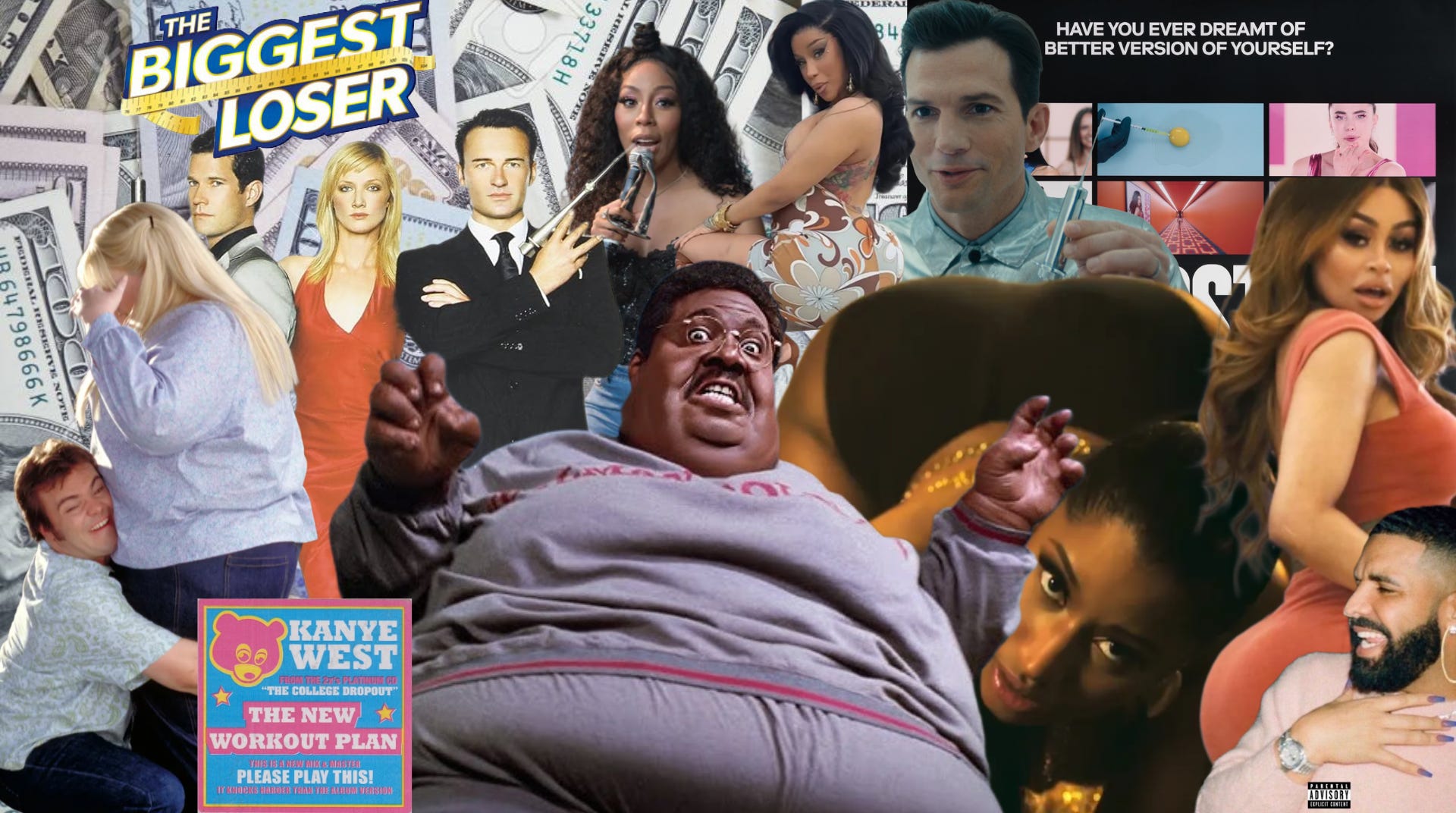
All the aughts movies and shows stressed the idea that a double chin was an albatross around your neck, that bags under your eyes stopped you from getting the bag, and that fatness determines your fate. Our economic hierarchy, as Rock said in Down to Earth, was “all about looks.” If you had them, if your bust burst at the seams, and your waist seemed to be wasting away, then you could live in exotic villas and hotels for free, yet if you were as big as a house, you’d always have to pay your own rent. This phenotypical division of value and labor was reiterated in hip-hop with even less tact.
Who could forget Lil Wayne’s longing for “a long-haired, thick redbone” or his loathsome rebuke on “A Milli”—“You like a bitch with no ass; you ain’t got shit.” Even enlightened rappers like Andre 3000 pleaded with the Lord for a woman with the right measurements as he prayed on Speakerboxxx/The Love Below’s “God”—“I’m not bein’ picky. She doesn’t even have to have a big ol’ ass, you know? Just something well-proportioned to her body. You know, a nice little tail, you know?”
There was Kanye West’s “The New Workout Plan.” There was TI’s “Whatever You Like.” There was Snoop’s “Beautiful.” There were innumerable tracks flattering women with flat stomachs and fat asses, promising those with hourglass figures that they would never have to clock in again. In the 2010s, Drake perfected this glamour ode, narrating ghetto fairy tales in which some mesmerizing employee, toiling away at Hooters, would be plucked from obscurity and rescued from a life of minimum-wage drudgery. Like Disney’s fairy tales, Drake’s fairy tales would only come to the rescue of the comely. Just as Snow White had to be “the fairest of them all,” Rapunzel had to have bundles of hair, and Belle had to be the Beauty to be saved by the Beast, if you wanted Drake to be your “knight in shining Armor All tires” then you needed to look like a princess. If you wanted to wear Tiffany and Cartier, you had to be a diamond in the rough—your skin had to be smooth as opal and shine like gold.
Decades of songs in which the good-looking were never overlooked have created our common language around beauty, capitalism, and escape. Listen to Jasmine Sullivan’s “The Other Side,” where she yearns to escape work and rent while crooning, “I’m hoping these titties can get me out the city/I know I’m too pretty to not do nothing with it.” And then comes the pre-chorus:
(Fuck a day job)
So I’ma move to Atlanta
(Want a big house in the suburbs)
I’ma find me a rapper
(With a pool in the back)
He gon’ buy me a booty
(Get my ass done, fat transfer)
Whether Sullivan on “The Other Side” singing “I’ma stay fit, get a facelift” or Yung Miami on “Jobs” spitting “spend a couple thousand on my titties and my ass cheeks” or Stunna Girl on “Pretty Privilege” rapping “Never worked 9-to-5s, I got pretty privilege,” even in hip hop’s era of women empowerment, the message remains that the right figure is key to landing seven figures. In our choruses and in our communities, Black folks say that recomposing the fat in your thighs will make money fall in your lap, that moving the jelly from your belly to your butt will have you sitting pretty.
Scarred by the travails of capitalism and traumatized by the horrors of wage labor, there is a sense that Black women now have two options: go to work or get a BBL; either way, it’s going to be a pain in the ass. So why should you be miserable working your ass off when you can make your ass work for you?
This is the question plastic surgeons pose every day. Doctors know that struggling cashiers and waitresses are having breakdowns in break rooms from coast to coast. They know that low-wage laborers crave escape, that they want to be “saved.” This is why cosmetic startups sell campaigns telling Black women that if you go under the knife, you will finally get your piece of the pie. That if you get a rhinoplasty, you won’t have to keep your nose to the grindstone. That if you go through enough pain, you won’t ever hurt for money again. More than just strange or bizarre, these ads pitching a pillow face as the key to a soft life aren’t just cynical—they are fascist.
Fascism, among other things, is an obsession with a “master race’s” physique. It is a highly aestheticized crusade preoccupied with anatomy, with skull structure, hair color, skin pigment, and muscle definition. Our ancestors loathed fascism, defeating it in Germany and Italy during World War II. Yet, one cannot help but see the fascism in today’s BBL capitalism; one cannot help but see the way we worship smoothness, perkiness, and thickness—the way we reward some bodies and ridicule others. We’ve placed surgical alterations atop an altar, deifying the very body politics we once defied.
To live in our age of debt-financed butt lifts is to watch the frightening ways in which fascism and capitalism reinforce each other. It is to watch capitalism’s propensity to use violence to extract value, turned on our own torsos. We mine ourselves to create wealth. We drill into our stomachs. We frack our hips. We excavate our backs. We conduct conquests on our bodies so that we may adhere to a politically idealized physique—so that we may be full participants in America’s Herrenvolk capitalism.
Ours is a dystopian age where a beauty pageant owner is the president, where the defense secretary heckles “fat generals and admirals” and “fat troops,” where the White House excoriates reporters as “ugly and piggy,” and where elementary schools implement the “Presidential Fitness Test” to mold children into a worthy physical form.
We are drowning. As Ta-Nehisi Coates notes, the thrust of the Black freedom struggle wars against “the need to ascribe bone-deep features to people and then humiliate, reduce, and destroy them.” We are supposed to oppose “the belief in the preeminence of hue and hair, the notion that these factors can correctly organize a society and that they signify deeper attributes, which are indelible.” Thus the import of King’s call to become a nation where people “will not be judged by the color of their skin but by the content of their character.” Thus, the import of “Black is Beautiful.” The Black vision of a just society is supposed to be one where physical difference makes no difference at all. Yet it feels as if we are barreling towards something much more bleak.
In 1931, George Schuyler published Black No More, a satirical novel in which the mad scientist Dr. Junius Crookman, hoping to liberate Blacks from racism, creates a cosmetic procedure to turn Black people white, to make Black people adhere to the aesthetic preferences of fascism.
It is a surrealist story replacing political mediation with scientific innovation. Through pluck and hustle, Crookman drives the price of the procedure down so low that all Black people could be converted to white and thereby be free of the travails of discrimination.
The absurdist afrofuturistic novel is meant to draw attention to the ways in which people were treated disparately because of their race. It’s supposed to make us ask, what would it mean for us to live free both of phenotypical discrimination and also capitalist hoarding? What would it mean to live in a society in which your job wasn’t so horrible that you would be willing to destroy your body and risk disfigurement to escape it? What would it mean to live in a world in which the way you looked had nothing to do with the way that you were treated?
Yet today, it feels as if America has read Schuyler’s dystopian fever dream as an instruction manual. Listening to Drake’s Iceman boast “I put CC’s on that ho just like a titty surgeon,” you feel the cultural currents flowing towards a perverted vision of biomedical justice—not towards Dr. King’s colorblind society, but towards Dr. Crookman’s society where everyone is the right color. Today we are not building a socialist utopia where there is a chicken in every pot, but one where we subsidize a lipo for every pot belly.
This is the world we are leaving to our children, a world that tells them if they want to be “gorgeous,” they should gorge less; if they want to make more dough, they should eat less bread, and if they fear becoming homeless, they should never look homely. Because if you want to make it here in America, if you want your piece of the greatest economy in the world, then you must learn to grate down your bones, cartilage, and soul.
PS: If you missed it, don’t forget to read last week’s piece on hip-hop and wage labor!

This reminds me how Kanye’s Flashing Lights was the used for the Nip/Tuck promo and his mom died while getting surgery. It’s actually really sad the lengths we’re encouraged to go to just to be treated kinda fairly
I think like other forms of Blackface, the BBL is obsessed with a poorly reproduced, uncannily artificial version of the real thing. Those who engage in it only want their idea of Blackness and they wield their frankenstein mimic around like a voodoo doll. The idea of the BBL is to copy the IDEA of a stereotypical Black woman’s features without any regard for the effect of the disdain of realism and disregard of histories of misogynoir. To read this body as nothing but a terminally available sexual object is to reject the idea that the body could ever form itself properly, that it has any subjectivity, could know what it wants. The fact that a woman’s body has functions and purposes outside of sexual availability, eg walking, supporting itself, supporting something heavy, is anathema to the cult of the bbl (or misogynoir more generally) and thus why folks are walking around with thighs that don’t match, implants that make them sick, and all sorts of unaddressed pain issues. That is the essence of blackface, the appropriation itself: all performance and subservience and consumability, no concern for the pain, labor, and humanity behind it.